
The particular group of reed woodwind musical instruments characterized by the oboe, clarinet, oboe d'amore, English horn, basset clarinet and straight soprano saxophone are small enough to be made essentially rectilinear from one end to the other. However, due to the intricate amount of key work, the weight of these instruments in playing position is usually greater than the amount that occurred in their primitive ancestors. In present-day forms, they are all made with a conventional thumbrest located on each instrument at a location that approximately allows the right-hand thumb of the player to support the instrument while allowing the other fingers of the right hand to manipulate the different keys or tone holes of the instrument in playing. The left-hand thumb in playing these instruments is assigned the task of acting on at least one key that produces the higher-register notes in combination with the action of the other fingers of both hands. Thus, the left-hand thumb provides practically none of the support against the weight of the instruments, because its position on the instruments is completely away from the center of gravity of the instruments in the usual playing positions. The left-hand thumb initiates the instruments into playing position. In addition, it assists the player's embouchure, defined in the art as the formation of the player's lips and teeth around the mouthpiece of the instruments, thus stabilizing the instruments during playing. It is well known to any player that balancing one of these instruments with the delicate embouchure and the fingers of both hands against the weight of the instrument requires a great amount of skill to be acquired through hours of practice and constantly increasing pain in the right-hand thumb that has to support the majority of the weight of the instrument.
Further analysis reveals that the player's embouchure cannot contribute generally to support the weight of the instrument because it is far away in all usual playing positions from the center of gravity of the instrument. Practically the total weight of an instrument in this particular group during playing is supported by the thumb of the player's right hand. Consequently, with just a conventional thumbrest on an instrument of the group, considerable strain in the right hand and its thumb is felt by the professional, amateur or student musician players, during prolonged musical performances or practice sessions. The strain may become so unbearable that it hinders the ability to play the instrument. Continuous strain can cause severe repetitive-strain syndrome in the right wrist and known to have compromised or terminated promising musical careers or cause considerable frustration of many players who are unable to produce the unique musical sounds that they aspire for themselves in playing one of these instruments.
One of the most obvious and successful methods of relieving the weight of any woodwind musical instrument in playing position is to use a supporting strap. One way is to anchor the strap comfortably around the neck. Another way is to wear the strap around the back on one or both shoulders such as found on a class of very heavy bassoons, contra-bassoons, bass clarinets or saxophones of any size with a pronouncedly curved neck near the mouthpiece. These successful straps include a hook which fits through a ring integrally formed on the thumbrest of this class of instruments. The length of the straps is adjustable into a fixed amount by each experienced individual player before playing and would not need any further adjustment during playing. However, when these successful straps are similarly designed into straps for the group of instruments characterized by an oboe and a clarinet, these latter straps are known to be rejected by any experienced player as not helpful at all, and even considered dangerous. The cause of this peculiar poor performance becomes obvious when the players have had the time or a chance to evaluate these latter straps with some engineering analysis. The cause of success of the straps of the group characterized by the bassoons and saxophones with a curved neck is that the mouthpiece on all of these instruments is oriented in a way that when a strap's length is properly adjusted by an experienced player for the proper angle or any other angle of playing, the right thumb of the player just has to push the thumbrest away from the player's body to reduce the pressure of the weight on the right thumb. Because of the strap, these curved-neck instruments can only move the mouthpiece up in an arc in front of the player and into the player's embouchure more or less precisely for playing but not haphazardly to the point of jamming the reed into the player's lips or teeth in an unexpectedly constrained manner.
Observing the success of this group of straps leads to the understanding of the real cause of poor performance of the straps designed for the group characterized by the oboes and clarinets: that is, the lack of a curved neck near the mouthpiece on these instruments. Regardless of being adjusted by an experienced or novice player, when the fixed length of the strap of this group of instruments is determined, the weight relief on the right thumb is perceived only through a definite small arc described by the thumbrest around one point on the back of the neck of the player with the radius defined by the already-fixed length of the strap. The only way to continue to perceive the weight relief on the right thumb and to suitably position the instrument mouthpiece to the player's embouchure is governed by two constraints. First, move the thumbrest so that it would be at the maximum distance from the back of the player's neck determined by the already-fixed length of the strap. Next, make the angle of the straight body of the instrument and the straight line formed by the strap between the back of the player's neck and the thumbrest to be the same angle that was chosen during the preliminary adjustment of the strap. It can be appreciated that satisfying both of these constraints at the beginning and during playing one of these instruments with the correct embouchure is very difficult and exasperating. Moreover, one can imagine intuitively that satisfying strictly the first constraint while not satisfying the second can lead easily to the danger of jamming the reed into the player's lips or teeth accidentally with regrettable consequences.
After years of refinements the present version of the OCGenie offered to the public overcomes successfully all the deficiencies of others products available up until now.
To visualize easily the design and operations of the OCGenie, please refer to FIG 1 that shows the sketch of a player using the OCGenie while playing a Bb clarinet.
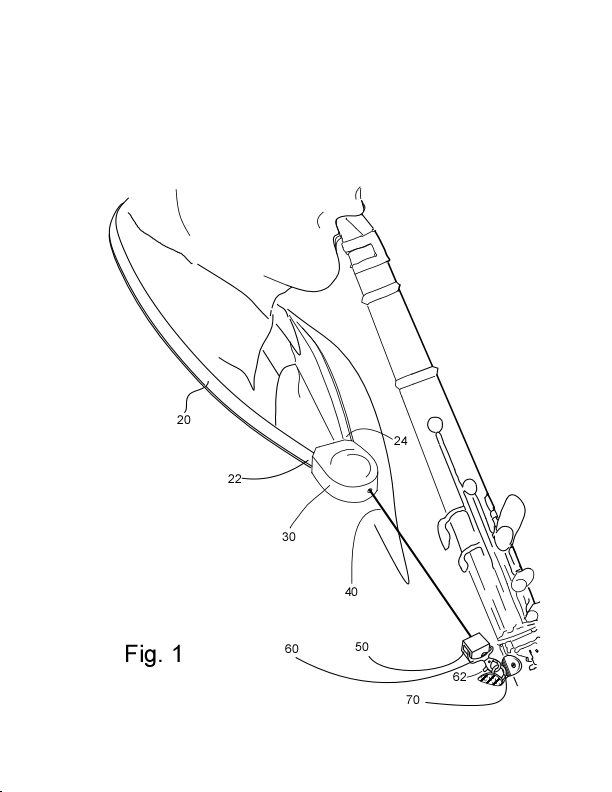
The manner of using the OCGenie on a woodwind instrument of the group of instruments that include oboes, clarinets, oboes d'amore, basset clarinets, and English horns comprises quick steps of assembly that can be varied or simplified further when experience in using the OCGenie is increased. Referring to Fig 1, the steps are as follows:
All these eight steps can be taken by a teacher to assemble the OCGenie on a young student's body and instrument for the first few times, or by any player who can follow the written instructions included with the OCGenie.
Now, the player can hold the instrument with both hands in the familiar manner and put the instrument into playing position by raising the whole instrument with the right-hand thumb and by tilting the instrument around the thumbrest, naturally, with the left hand, and by visually guiding with total freedom the mouthpiece of the instrument with both hands into the embouchure. Owing to the combination of the suitable length of strap 20, the suitable constant pulling force on cord 40 on the thumbrest, and the generally adopted playing positions of the instruments pointing to the ground, this total freedom is realizable for the player. This freedom experienced by the player in raising the instrument into playing position and during playing at any angle pointing the instrument to the ground, is the sensation of no strange force in any direction on the two hands except the familiar force of the weight pushing down on the right thumb. However, this force would be drastically diminished due to the real physical force resulting between of the original force on the thumb before the adoption of the OCGenie, and the well calculated up-pulling force that the OCGenie is vigilantly exerting now on the thumbrest. This up-pulling force creates physically a component force in line with but opposite to the gravity force (attracting force directed toward the center of the earth due to the masses of the earth and of the instrument; pardon the scientific jargon) of the weight of the instrument on the thumbrest, and thus will diminish the weight by an intended amount to provide a perceivable relief on the player's right thumb.
The OCGenie and SopSaxGenie are calibrated carefully to relieve as much as possible the weight on the thumbrest. However, a little weight is designed to remain on the thumbrest. The player will feel liberated from thumb pain raising the instrument into playing at any angle pointing the instrument to the ground. No sensation of strange force on the two hands, except the familiar weight pushing down gently on the right thumb. Using the OCGenie, some players told us they crossed over the break and get all the high notes on a clarinet more easily. Also, easier and clearer high notes on the oboe and straight sop sax were reported.
Playing an instrument pointing into any direction above its horizontal position can be accommodated also by the OCGenie. Here, the players can stabilize the instrument with the embouchure and a grip of at least a thumb and a finger of the left or right hand so that the playing can be continued in the presence of a force toward the embouchure. This should be easy for experienced players who may go into these angles of playing only during some brief moments of music presentation.
Where a thumbrest ring does not exist on any of the instruments, the OCGenie provides readily two (2) innovative and reliable thumbrest ring attachments that can be installed on two of your instruments in a few minutes. This will save the high cost (eventually 2 X half-hour work = $60) of replacing the player's thumbrest with one that has a ring already soldered on, or the agony of waiting and paying a qualified instrument technician to solder a metal ring on it, ruining the good look of the thumbrest in the process.
Each ring attachment comprises an essentially circular ring of nylon tie loop enrobed with a plastic tubing, and secured onto a conventional or adjustable thumbrest commonly available, with another nylon tying loop. These nylon round loops and tying loops are specifically made only with the high-performance cable ties available under the trade name Ty-Rap. These ties are produced with a good grade of nylon and have a sharp stainless-steel catch that allows a tying loop to stop at an infinite number of points along the body of the loop, and at the same time maintains the loop with proven great strength and durability. Vinyl tubing is chosen as soft enough to allow the tying loop to do the best job in immobilizing securely the round loop onto the upper surface of the thumbrest, and at the same time, hard enough to work properly with the OCGenie snap-hook.
This ring attachment has been proven to work
dependably and never to alter the priceless familiar feel of the instrument at
the thumbrest. No modifications at all on the instruments before a thumbrest
ring attachment is put into use. It can be removed, if necessary, with a
household tool such as a nail clipper.